Boureima Amadou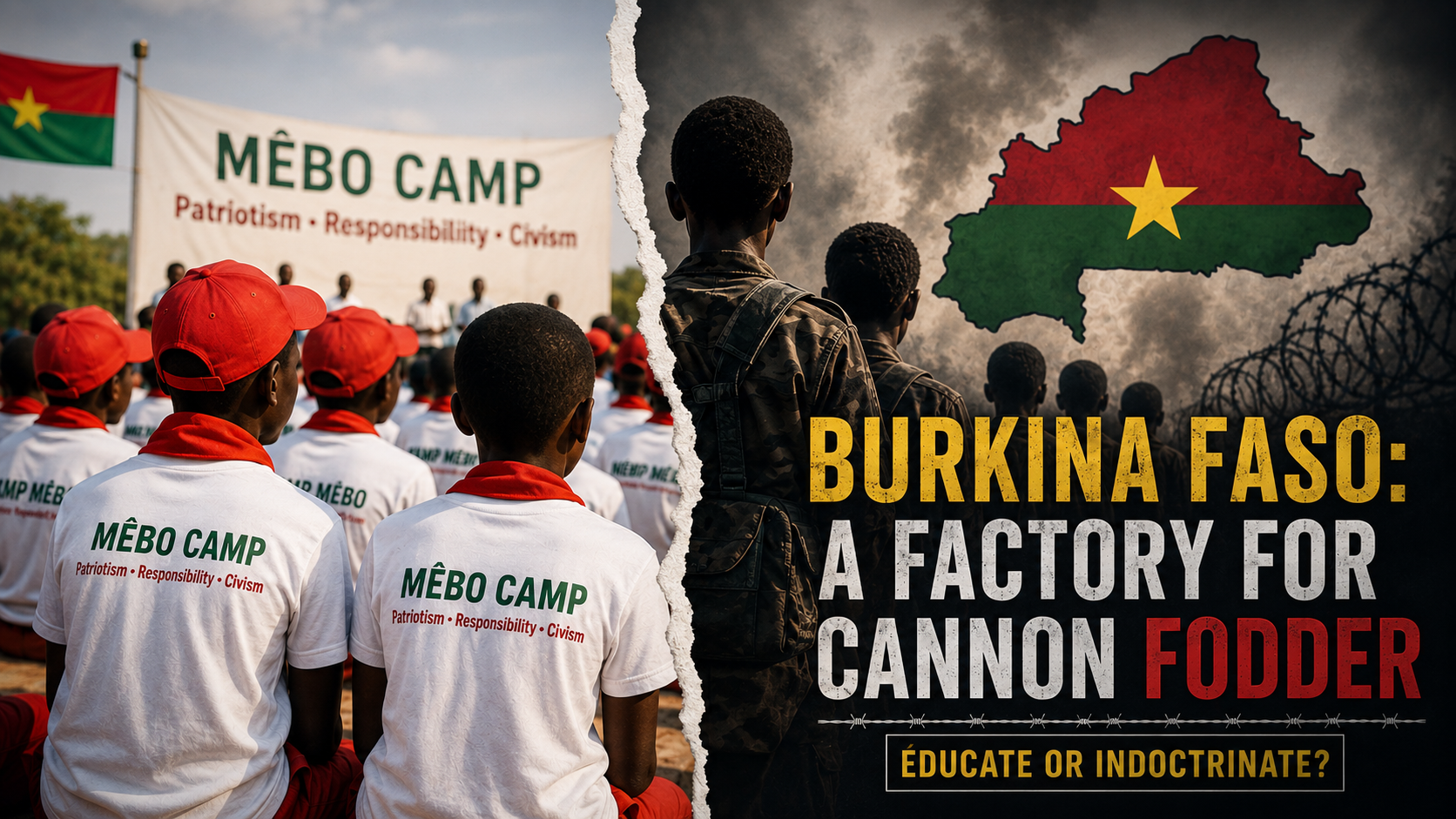
At first glance, the initiative appears to be a conventional community undertaking. In Burkina Faso, the Mêbo holiday camp brought together thousands of young people for cultural, sporting, and communal activities. The official directive from authorities was clear: to cultivate patriotism, responsibility, and civic duty from an early age. Yet, beneath this ostensibly virtuous institutional façade, a more troubling question has begun to surface in public discourse: could these extensive gatherings also signify the early stages of a progressive militarisation of the nation’s youth?
The fine line of civic instruction
The issue, naturally, does not lie with the teaching of civics itself. Imparting a sense of responsibility, respect for institutions, solidarity, and the common good to young individuals can be entirely legitimate. The concern arises when patriotism transforms into a tool for political mobilisation, when critical thinking is overshadowed by blind obedience, and when national defense is presented as an unending obligation. This is where the boundary becomes disquietingly blurred.
Regrettably, this strategy is not unprecedented on the African continent. Recent history illustrates that doctrines of early enlistment or indoctrination frequently follow analogous patterns. From Sierra Leone to Liberia, and extending to the northern regions of the Democratic Republic of Congo, the distinction between patriotic awareness, ideological mobilisation, and the recruitment of youth in conflict zones has, at times, proven exceedingly fragile. When those in power exploit national sentiment among a young, still-developing populace, there is a distinct risk that civic education will gradually evolve into an instrument of mobilisation.
The power of language and symbols
Another element warranting close observation is the lexicon employed. When concepts such as homeland, sacrifice, enemy, national defense, and commitment are consistently intertwined in messages directed at young people, they can inadvertently normalise the notion that military service to the country represents the natural destiny of a young citizen. However, a child or adolescent should first learn to reflect, debate, innovate, and build before being called upon to sacrifice for a political or military cause.
Within the Sahel’s acutely volatile security landscape, the decisions made by Ibrahim Traoré’s (IB) administration thus provoke particular scrutiny. Burkina Faso is contending with a conflict that has profoundly reshaped society, displaced populations, and elevated the matter of national defense to the forefront of public discussion. In such an environment, patriotic mobilisation can readily assume an intensified dimension. The pivotal question then becomes one of limits: how far can one reasonably go in instilling a spirit of defense in the youth?
Preserving critical thought and agency
By cultivating a youth intensely mobilised around the official narrative, does the government not risk, consciously or inadvertently, progressively diminishing the scope for dissent and critical inquiry? A truly engaged citizenry among the youth should not, however, be one that systematically endorses those in power. It ought to be capable of defending its nation while simultaneously questioning its leaders, respecting the country without conflating nation with regime, and serving the community without becoming a mere political instrument.
The peril also lies in prematurely normalising the concept of sacrifice. By continuously portraying death in combat as the ultimate manifestation of patriotism, one risks rendering an inherently dangerous understanding of national duty acceptable to the younger generation. Yet, love for one’s country should not be gauged by a child’s capacity to embrace violence, but rather by their readiness to contribute to education, healthcare, agriculture, innovation, social cohesion, and the development of their nation.
Consideration must also be given to the prominence of uniforms, military emblems, and belligerent rhetoric in these types of activities. Taken in isolation, none of these elements necessarily constitutes definitive proof of militarisation. However, their cumulative presence, especially within a context of ongoing conflict and perpetual national mobilisation, demands particular vigilance. It is precisely within these ambiguous zones that the distinctions between civic education, patriotic propaganda, and psychological preparation for military engagement can gradually erode.
The fundamental question of age
The age factor is equally fundamental. An adult, capable of comprehending political and military complexities, can make an informed choice regarding their involvement. A child, conversely, possesses neither the same maturity nor the same capacity for discernment. It is therefore incumbent upon institutions to safeguard them against any form of exploitation and to ensure their education serves as a pathway to empowerment rather than a means of producing citizens entirely subservient to a confrontational ideology.
In the face of an urgent security crisis, the temptation to militarise minds is considerable. Nevertheless, responding to a military threat by ideologically preparing an entire generation for confrontation risks creating a self-perpetuating cycle. The more society accustoms its young people to thinking in terms of enemies and sacrifice, the greater the likelihood that violence will become an accepted response to political and social disagreements.
Genuine patriotism should, in fact, facilitate an escape from this very logic. To love Burkina Faso is not merely to be willing to die for it. It is also to desire its sufficient stability so that its children can live, study, work, and forge their futures without being perpetually confronted by conflict. It involves accepting that citizens can support their nation while critically appraising its government.
Before unreservedly applauding discourses on patriotism and youth mobilisation, it is imperative to seek assurances: What are the pedagogical objectives of these camps? How much emphasis is placed on critical thinking? Are children free to express dissent? Do the activities include a military or paramilitary dimension? And crucially, where is the boundary between cultivating responsible citizens and preparing a generation to accept war as an inevitability?
Burkina Faso requires an engaged, educated, and responsible youth. However, it must also ensure that this youth retains its free will. For preparing the citizens of tomorrow to build their country is a national aspiration. Preparing them to become instruments in an unending confrontation would be an entirely different proposition.
The fundamental question thus remains: are these children being prepared to construct the Burkina Faso of tomorrow, or to serve as cannon fodder in future conflicts?