Mariama Hamani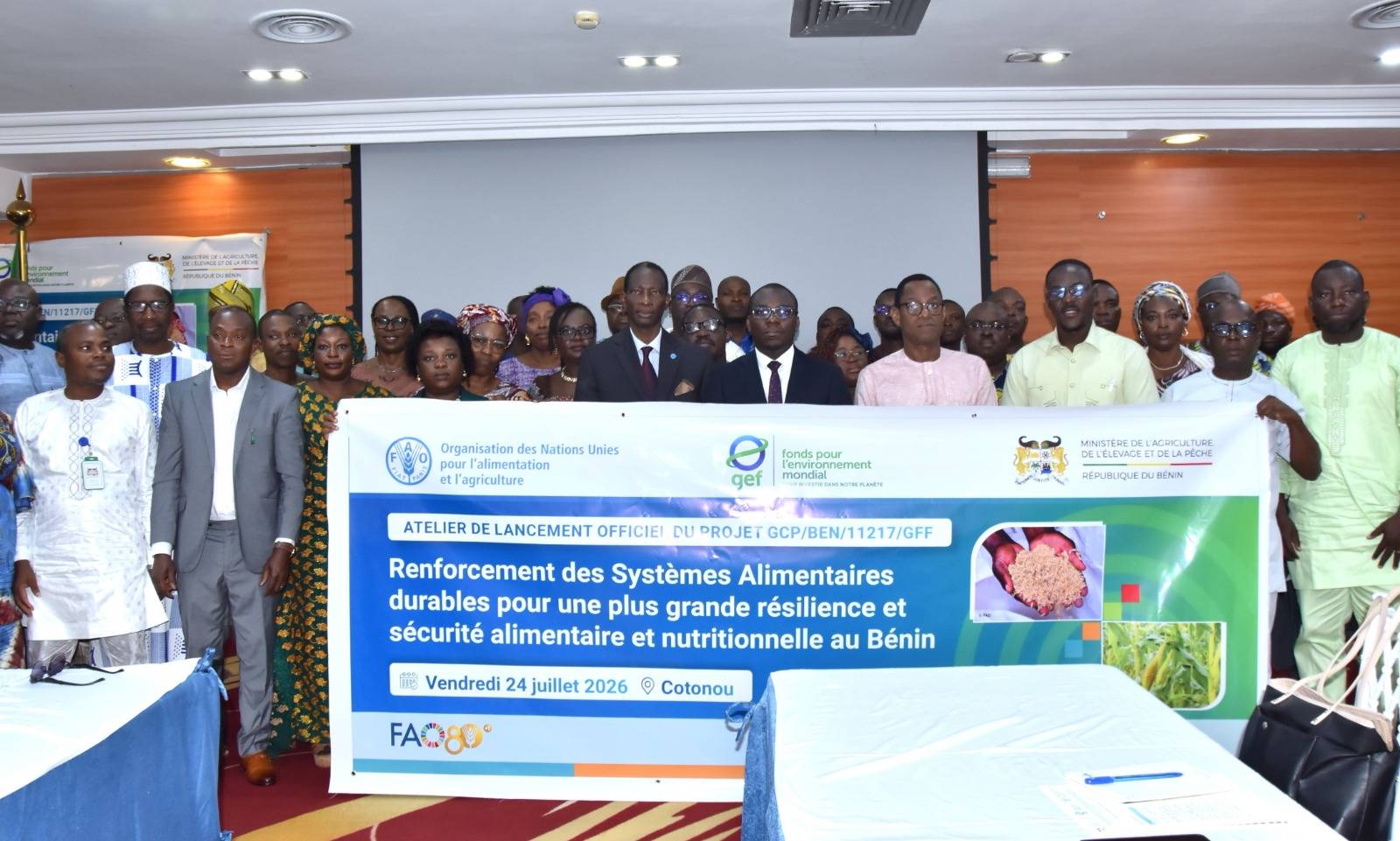
Bénin’s soil crisis: A threat to food security and national prosperity
Benin’s agricultural sector is the backbone of its economy, accounting for 70% of jobs, contributing 26% to GDP, and generating 80% of export revenues. Yet, this vital sector is under severe strain due to the relentless degradation of farmland. Speaking at the launch of the Food Systems project in Cotonou’s Bénin Royal Hotel, the Minister of Agriculture, Adin Yeton Bloukounon Goubalan, delivered a stark warning: “Depleted soil means poor harvests, which traps farmers in a cycle of poverty.”
Official data paints a grim picture: over 5 million Beninese—nearly 40% of the population—face the direct consequences of land degradation. Shockingly, 38% of the country’s total land area is now classified as degraded, slashing agricultural yields by at least half and jeopardizing access to essential resources like water and food for rural communities.
Food Systems: A groundbreaking shift in Benin’s agricultural model
The new Food Systems initiative, developed in collaboration with the UN’s Food and Agriculture Organization (FAO) and the Global Environment Facility (GEF), represents a paradigm shift in how Benin approaches agriculture. Rather than addressing symptoms in isolation, the project targets systemic change to rebuild resilience in the country’s food systems.
The initiative focuses on two critical staple crops—maize and rice—which are central to both rural and urban diets. By modernizing public policies, adopting advanced farming techniques, and enhancing market access, the project aims to transition these sectors from low-yield, environmentally harmful practices to high-performance, sustainable systems that deliver tangible socio-economic benefits.
A targeted investment for measurable impact
To drive this transformation, a $20.7 million budget has been allocated, combining $5.9 million from the GEF and $14.8 million in national co-financing. The project will unfold over five years, with interventions concentrated in five strategic communes: Karimama, Malanville, Glazoué, Kétou, and Les Aguégués.
The expected outcomes are substantial: 20,000 hectares of degraded land restored, sustainable farming practices extended across 114,900 hectares, and direct benefits reaching 36,000 farmers. Indirectly, the initiative will positively impact 356,000 people in the targeted regions.
Challenges and collective action for long-term success
While the project’s goals are ambitious, its success hinges on overcoming significant operational hurdles. Minister Goubalan emphasized the need for meticulous planning, particularly in selecting soil restoration technologies that are both effective and scalable. “The right methods are the difference between success and failure,” he noted.
The FAO’s Resident Representative in Benin, Paul-Henri Zoéwindé Bouda, underscored the importance of grassroots engagement: “This project will only thrive if every stakeholder—from policymakers to local farmers—works in unison.”
A blueprint for sustainable food security in West Africa
By tackling the root cause of land degradation, the Food Systems project could redefine Benin’s agricultural future. If targets are met by 2030, the country could not only secure its rice and maize supplies but also set a replicable model for ecological transition across the region.


 Boureima Amadou